

Whether you're building a tiny home, outfitting a remote cabin, or designing a commercial off-grid facility, one challenge always comes up: what do you do about the toilet? The good news is that modern waste management technology has come a long way. The bad news is that not all solutions are created equal.
Here, we break down the two leading categories of off-grid toilets — incinerating and composting — and show you why the TinyJohn™ by ECOJOHN stands out from the pack.
Visit www.ecojohn.com for more details
🌿 Two Approaches to Off-Grid Waste
Before diving into comparisons, it helps to understand the basic technology at play.
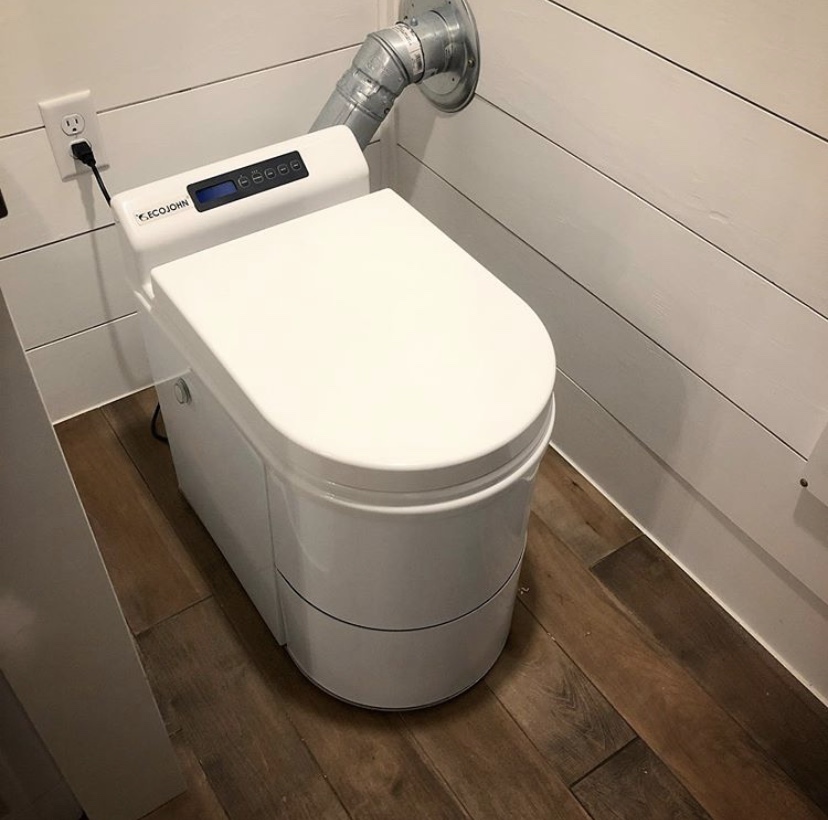
Incinerating toilets burn waste at high temperatures, reducing it to a small amount of clean ash. There's no water required, no septic system, and no complex biological process to manage. The result is a hygienic, odor-controlled solution that requires minimal maintenance beyond periodic ash removal.
Composting toilets take a biological approach, breaking down waste over time with the help of organic bulking material (like peat moss or coconut coir). They're low-energy, but require hands-on management — monitoring moisture levels, turning the compost, and regularly emptying the holding container.
For most off-grid situations, incinerating toilets offer a more hands-off, sanitary experience. And within that category, the TinyJohn leads the field.
TinyJohn vs. the Competition
Flexibility That Others Can't Match
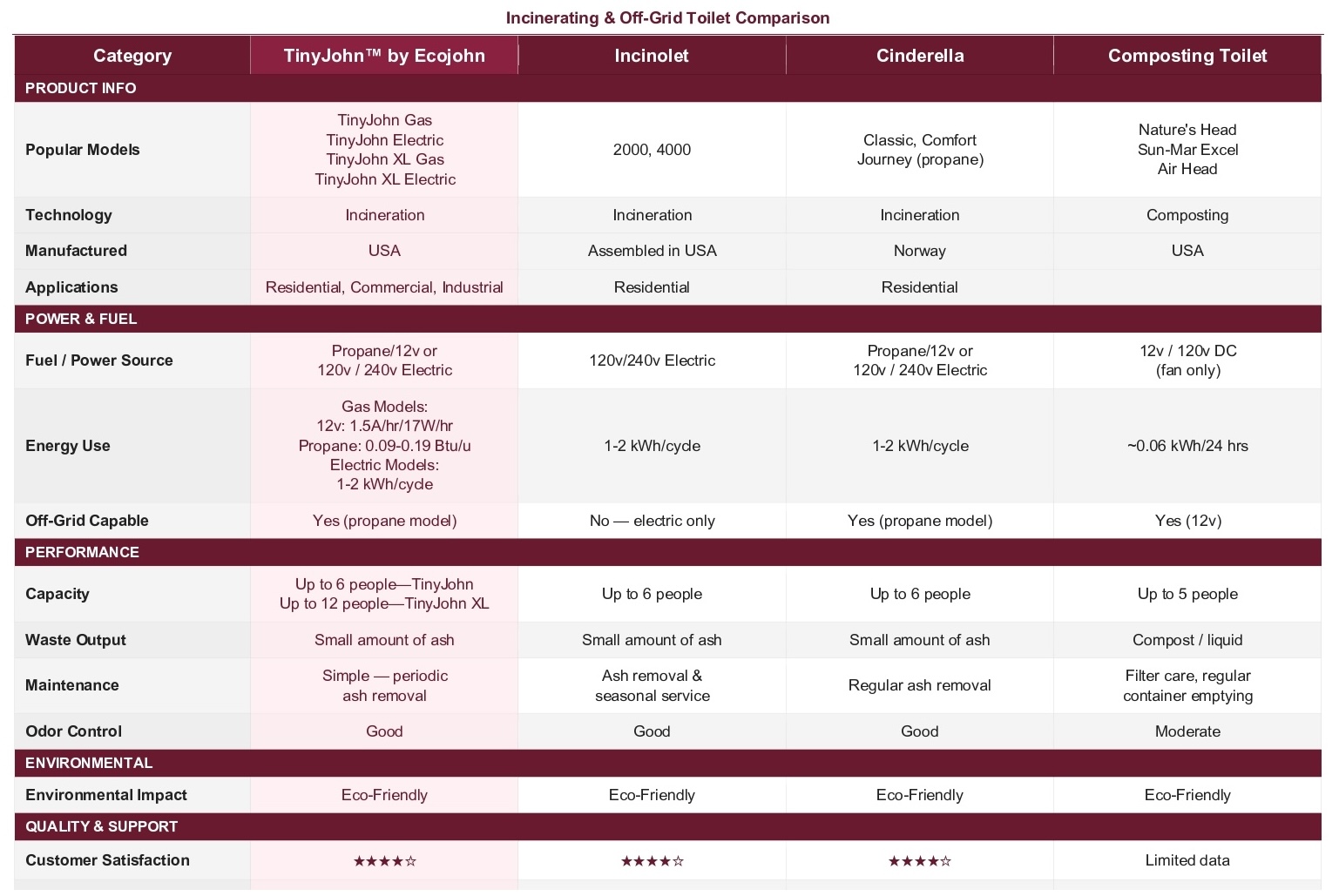
One of the TinyJohn's biggest advantages is its fuel and power versatility. It runs on propane with 12V DC power — making it fully off-grid capable — or on standard 120V/240V electric. The TinyJohn XL adds even more capacity for larger households or commercial applications.
Compare that to the Incinolet, which runs on 120V/240V electric only. No propane option means no true off-grid independence. If your solar system has a cloudy stretch or your generator goes down, you're out of luck. The Cinderella matches the TinyJohn's propane/electric flexibility, but starts at $4,395 — significantly more than the TinyJohn's starting price.
Built for More People
The TinyJohn handles up to 6 users, while the TinyJohn XL scales up to 12 people — a capacity no competitor comes close to. Incinolet and Cinderella top out at 6, and composting toilets typically max out around 4–5 users before requiring more frequent maintenance. For families, rental cabins, or small commercial applications, the TinyJohn XL is in a class of its own.
Smart Features, Thoughtfully Designed
The TinyJohn comes standard with features that competitors charge more for — or simply don't offer:
- Lid lock for added safety
- Auto shutoff to prevent overheating
- Advanced controller for precision operation
The Incinolet includes none of these. The Cinderella offers an advanced controller but lacks auto shutoff as a standard feature. These aren't just nice-to-haves — they're the kind of details that make a difference in daily use and long-term reliability.
Made in the USA
The TinyJohn is manufactured in the USA. The Incinolet is assembled in the USA from components, while the Cinderella is made in Norway. For buyers who prioritize domestic manufacturing and the supply chain reliability that comes with it, the TinyJohn wins outright.
The Best Value in the Category
Here's where things get decisive. The TinyJohn starts at $2,999 — hundreds less than the Incinolet (from $3,300+) and dramatically less than the Cinderella ($4,395–$5,995). Ongoing costs are fuel only, just like the other incinerating options.
Composting toilets start lower (around $1,500), but factor in the recurring cost of bulking material, the time investment of active management, and the more moderate odor control — and the value proposition shifts considerably.
Durability Built to Last
The TinyJohn is built to last 15+ years — longer than the 10+ year lifespan claimed by Incinolet, Cinderella, and most composting toilet brands. Backed by U.S.-based customer support available Monday through Friday, you won't be left searching for answers if something comes up.
The Bottom Line
.jpg)
When you look at the full picture — price, capacity, off-grid capability, smart features, and American manufacturing — the TinyJohn™ by ECOJOHN offers more than any competing product at a lower cost.
Whether you need a single unit for a remote cabin or a high-capacity solution for a commercial application, the TinyJohn is the off-grid toilet that doesn't make you compromise.
When you look at the full picture — price, capacity, off-grid capability, smart features, and American manufacturing — the TinyJohn™ by ECOJOHN offers more than any competing product at a lower cost.
Whether you need a single unit for a remote cabin or a high-capacity solution for a commercial application, the TinyJohn is the off-grid toilet that doesn't make you compromise.

